表达数量与比较
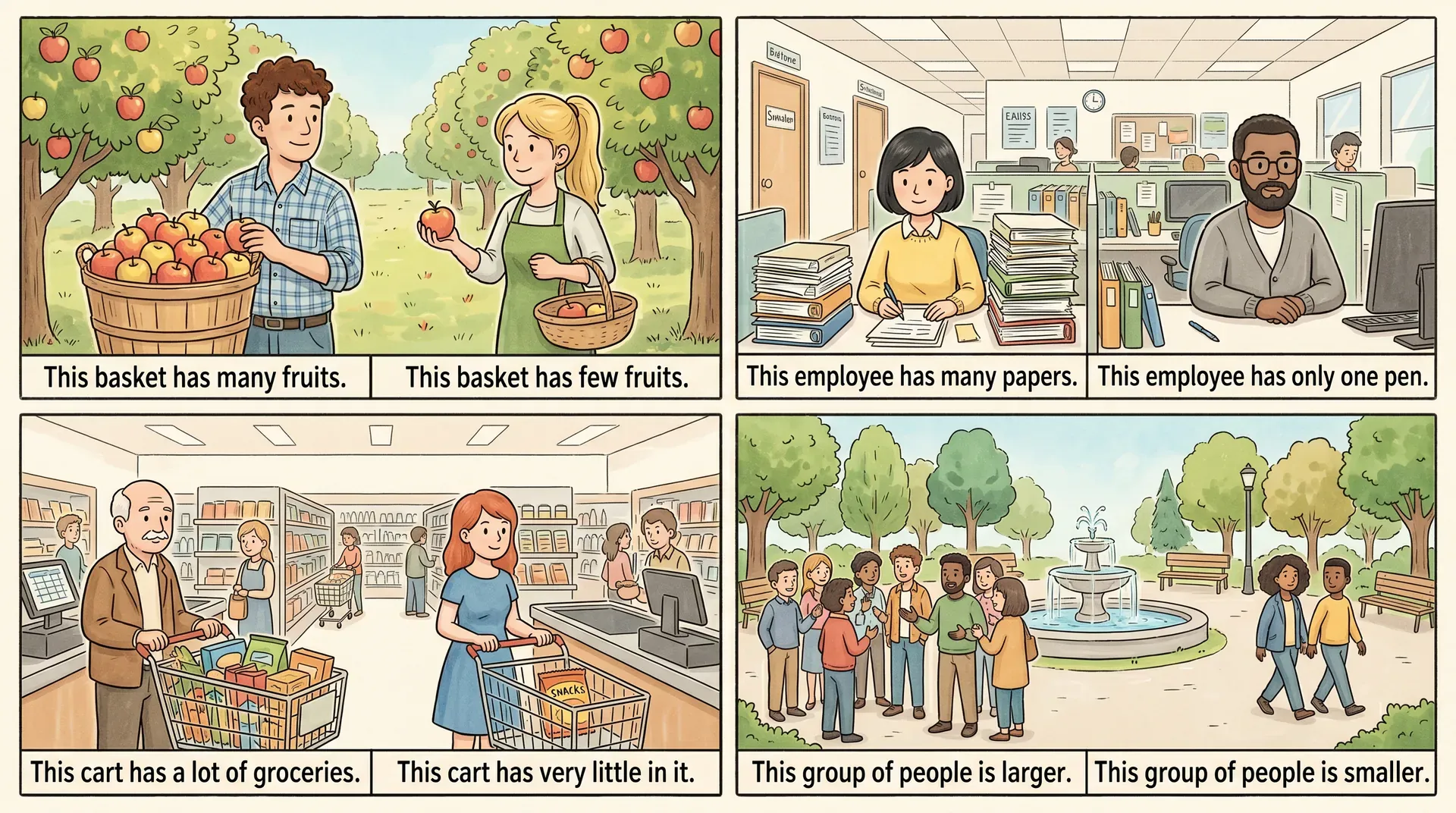
在生活中,我们经常需要比较事物,或者表达某种数量。例如:买东西时会问“哪个更便宜?”、“这两个产品哪个更好?”;朋友之间讨论身高时会说“你比我高三厘米”;谈论天气会说“今天比昨天冷很多”。此外,我们还会经常用到描述数量的词,比如“一些”“很多”“几乎没有”“只有一点点”等。
无论是在日常口语还是写作、考试等正式场合,准确和自然地表达数量及进行比较,都是非常重要的语言能力。比如,在点餐时需要表达饮料的多少,在购物时要比较价格高低,在学校也常常用到比较来说明成绩、速度、数量等方面的不同。能够灵活使用这些表达,不仅可以让交流更高效,还能让自己的表达更为丰富和地道。英语中,描述数量和进行比较有一套独特并且灵活的方法和句型,掌握好这些表达,会让我们在多种真实场景下都能自如应对。
数量表达
英语中,表达“数量多少”时,用什么词取决于名词是“可数的”还是“不可数的”。这是中文里没有的语法区分,需要特别记忆。可数名词和不可数名词的区分会影响所用的数量词、疑问句以及否定句。
可数名词(Countable Nouns):可以用数字数的事物,既可以单数也可以复数,前面可以加“a/an”,“every”等限定词。
- books, students, apples, days, people, chairs, cars
- 例句:There are three chairs in the room.(房间里有三把椅子。)
不可数名词(Uncountable Nouns):无法用数字直接计量的事物,没有复数形式,通常指物质、抽象概念或整体。
- water, rice, money, time, information, advice, music, bread, happiness, air
- 例句:She has little patience.(她几乎没有耐心。)
常见数量词及用法如下:
注意:
- “many” 和 “much” 一般用于否定句和疑问句中,肯定句一般用 “a lot of” 或 “lots of”。
- “some” 通常在肯定句和请求、建议句型中使用,而“any”常用于否定句和疑问句。
a few 与 few、a little 与 little 的区别不能忽视:
“a few friends”= 有几个朋友(正面,有一些) “few friends”= 几乎没有朋友(负面,几乎为零)
“a little time”= 还有一点时间(正面,稍微有一些) “little time”= 几乎没有时间(负面,情况不乐观)
这个区别常常在考试中作为陷阱,在日常交流中也影响表达的情感色彩。
扩展小结:
- “a few” 和 “a little” 带有肯定含义,“few” 和 “little” 带有否定含义。
- “much” 和 “many” 往往用于疑问句或否定句,“some” 则多在肯定句或礼貌请求中。
- “a lot of/lots of/plenty of” 用法更灵活,在口语和书面语中都常见,可以修饰可数和不可数名词。
- “several” 表示“几个”,只能修饰可数名词,且数量比 “a few” 要多一点。
- 日常交流中,选用恰当的数量词,不仅传递精确信息,还有助于表达说话人的主观感觉和态度。
用量词单位衡量不可数名词
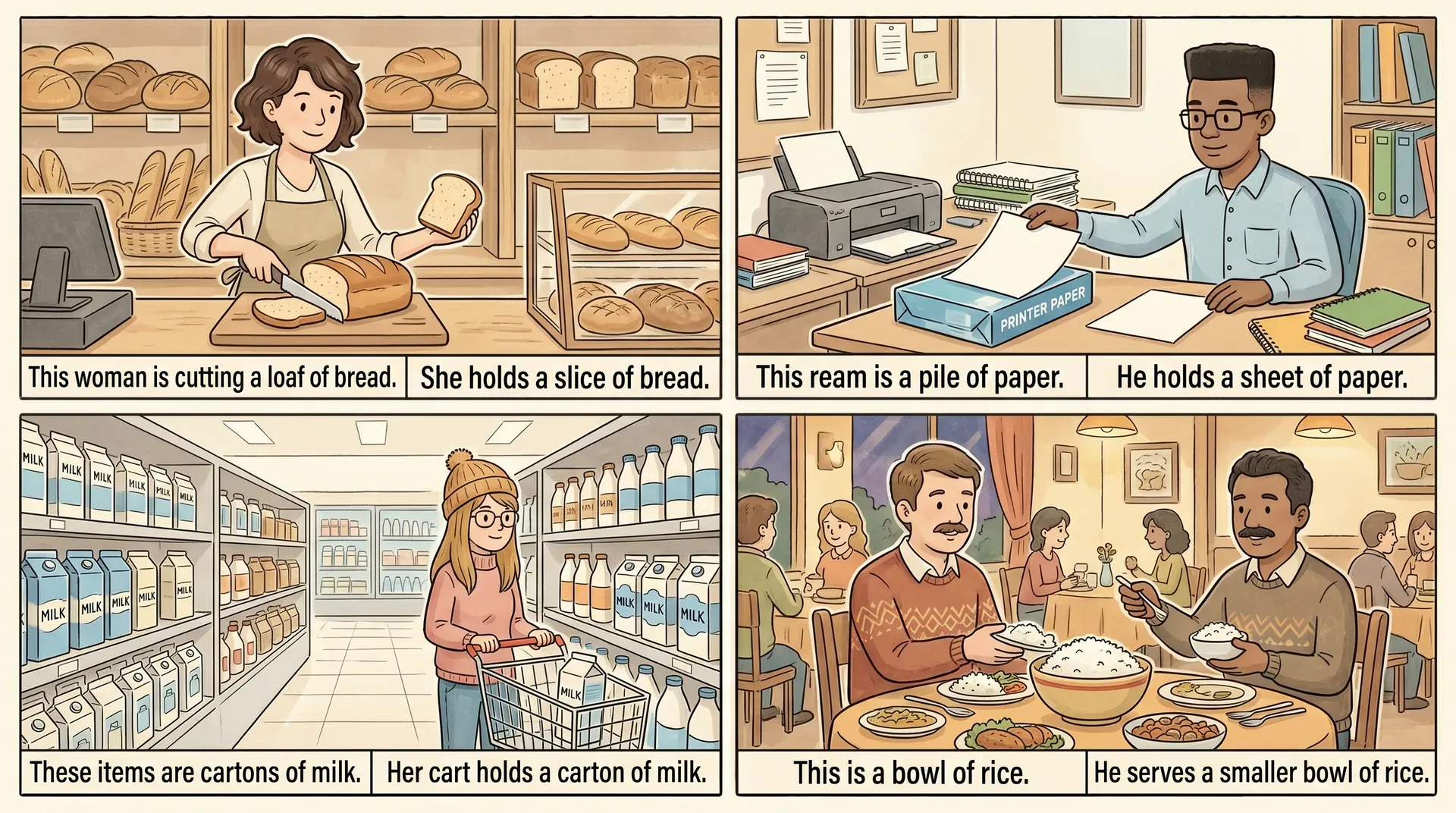
不可数名词虽然不能直接加数字,但我们可以通过“量词 + of + 不可数名词”的结构来表达具体的数量或分量。这样就把抽象的不可数名词变成了可以衡量、计数的单位。
你还可以根据实际需要组合数词和量词单位,例如:
- three slices of bread(三片面包)
- two bottles of milk(两瓶牛奶)
常见句型举例:
- Could I have two cups of coffee, please?(可以给我两杯咖啡吗?)
- She gave me a very useful piece of advice.(她给了我一条非常有用的建议。)
- There are four bags of rice in the kitchen.(厨房里有四袋米。)
- He drank a glass of wine at dinner.(他晚餐时喝了一杯葡萄酒。)
- Please buy a bar of chocolate for me.(请帮我买一块巧克力。)
注意要点:
- “advice/cheese/information/work” 等抽象、整体类不可数名词,常用“a piece of”等结构来计量。
- 某些量词也可以用于可数名词,如 “a box of apples”、但在表达不可数名词时格外常见和必要。
- 通过量词单位,可以将抽象的不可数名词转化为容易表达数量和分量的具体单位,非常有利于日常交流和准确传递意思。
练习思考:
比较级
比较两个事物时,使用比较级(Comparative)结构:形容词比较级 + than
比较级的构成规则:
| 规则类型 | 规则说明 | 例子 |
|---|---|---|
| 单音节词 | 直接加 -er | tall → taller cheap → cheaper |
| 以 -e 结尾 | 加 -r | large → larger nice → nicer |
| 辅元辅结尾 | 双写末尾字母加 -er | big → bigger hot → hotter |
| 以 -y 结尾 | y 变 i,加 -er | easy → easier happy → happier |
| 特定双音节结尾 | -y, -le, -er, -ow 结尾加-er | gentle → gentler narrow → narrower |
| 多音节/长单词 | 前加 more | expensive → more expensive |
| 不规则 | 特殊形式需记忆 | good → better bad → worse far → farther/further |
注意事项:
- 不是所有形容词都能灵活加-er,有些必须用 more,尤其是三音节及以上的形容词,或大多数以“-ful”, “-ous”, “-ing”, “-ed”等结尾的词,例:useful → more useful。
- 某些两音节形容词既可加-er,也可用 more,如:simple → simpler/more simple,但通常更推荐用-er。
- 辅元辅结尾法则中的元音指“单一元音”,并且末尾不为 w/x/y。 4 比较级常与 than 连用,但当对方已知省略 than 部分也成立。如:She is taller (than me).
常见副词比较级:
- 副词短(如:fast, hard)直接加 -er:faster, harder
- 副词长:more/less + 副词:more carefully, less easily
- 不规则:well → better, badly → worse, far → farther/further
常见加强比较的词语(可放在比较级前,表达“更...很多/稍微/有些”):
- much, a lot, far(更...很多):Tom is much taller than Jerry.
- a little, a bit, slightly(稍微/有些):She is a little more outgoing than her sister.
- even(甚至):This exam is even harder than the last one.
使用示例:
- This bag is cheaper than that one.(这个包比那个便宜。)
- She is more experienced than her colleague.(她比她的同事更有经验。)
- The weather today is better than yesterday.(今天的天气比昨天好。)
- My house is much bigger than yours.(我的房子比你的大多了。)
- This question is a little more difficult than the previous one.(这道题比上一道稍难一些。)
- He can run faster than anyone else in the class.(他跑得比班里的其他人都快。)
更多用法说明:
如果比较的对象是“越……越……”结构,英语中用“the + 比较级…, the + 比较级…”:
- The more you practice, the better you will become.(你练习得越多,你就会变得越好。)
可以通过重复比较级形式表达“越来越……”:
- It is getting colder and colder.(天气越来越冷。)
易错陷阱:
- 不要在 already 比较级前再加 more 等副词。例如,不能说 “more better”,应说 “much better”/“even better”。
- 记住 bad/worse/worst,good/better/best,far/farther/farthest 等不规则变化。
- 表达“比……更……多少”,一定注意加强词和比较级的搭配。
比较级的扩展用法
只用“A + 比较级 + than + B”会让表达单调。以下几种扩展让比较更精确:
表示差距程度:
- This hotel is much more expensive than the other one.(贵很多)
- Your score is a little higher than mine.(高一点点)
- He is far better at cooking than I am.(好得多)
用“the same … as”表示相同:
- My bag is the same price as yours.(我的包和你的一样贵。)
- She speaks English as fluently as a native speaker.(她说英语和母语者一样流利。)— as … as 结构
用“not as … as”表示“不如”:
- I am not as tall as my brother.(我没有我哥哥高。)
- This movie is not as interesting as the book.(这部电影没有书有趣。)
最高级
最高级(Superlative)用于在三个或以上的范围内比较,结构:the + 最高级形容词,即“the most/…est + 形容词”。最高级用来突出在同类事物中“最……的”那一个,常见于描述排名、选择等语境。
| 比较级 | 最高级 | 变化规则 |
|---|---|---|
| taller | the tallest | 短单词后缀直接加 -est |
| more expensive | the most expensive | 多音节词前面加 most |
| better | the best | 不规则变化,特殊形式 |
| worse | the worst | 不规则变化,特殊形式 |
| earlier | the earliest | 词尾 y 变 i 再加 -est |
| bigger | the biggest | 双写辅音字母再加 -est |
常见构成方法及注意事项:
- 一般一个音节的形容词直接加 -est(如 tall → the tallest, fast → the fastest)。
- 以不发音的“e”结尾直接加 -st(如 large → the largest)。
- 词尾辅音 + 单一元音结构需双写辅音再加 -est(如 big → the biggest, thin → the thinnest)。
- 多音节(通常是两个音节及以上)或部分以 -y 结尾的形容词用 most + 原级(如 careful → the most careful, interesting → the most interesting)。
- 注意 some 不规则变化(good, well → the best;bad → the worst;far → the farthest/furthest)。
使用示例:
- This is the cheapest restaurant in the area.(这是这片地区最便宜的餐厅。)
- That was the most exciting game I have ever watched.(那是我看过的最刺激的比赛。)
- She is the best student in our class.(她是我们班最好的学生。)
- January is usually the coldest month of the year.(一月份通常是一年中最冷的月份。)
- Who is the oldest person in your family?(你家里谁年纪最大?)
- This is the most difficult question on the test.(这是试卷上最难的问题。)
- Tom finished the race the earliest of all.(汤姆在所有人中最早完成比赛。)
否定用法及副词加强:
副词如 by far, easily, nearly 可以修饰最高级,强调“最……”“差不多最……”。
- She is by far the brightest student here.(她无疑是这里最聪明的学生。)
- This is easily the best film this year.(这无疑是今年最好的电影。)
有时用 not the 最… 表达“并不是最……”:
- He is not the tallest in the class.(他不是班里最高的。)
最高级后常见的搭配:
常见语境说明:
- 与具体范围(in my family, in the world, among all students)一起用,限定比较对象。
- 最高级常被用于建议、推荐、经验分享等语境(This is the best way to learn English.)在书面和口语中都极为常见。
易错提醒:
- 千万不可忘记“the”!(如 the biggest,不要只说 biggest。)
- 副词也有最高级形式(如 soonest, most quickly)。
- 三者及以上才用最高级,比较两者用比较级。
这两个搭配在口语和写作中都非常高频,值得优先掌握。
场景对话:购物比较
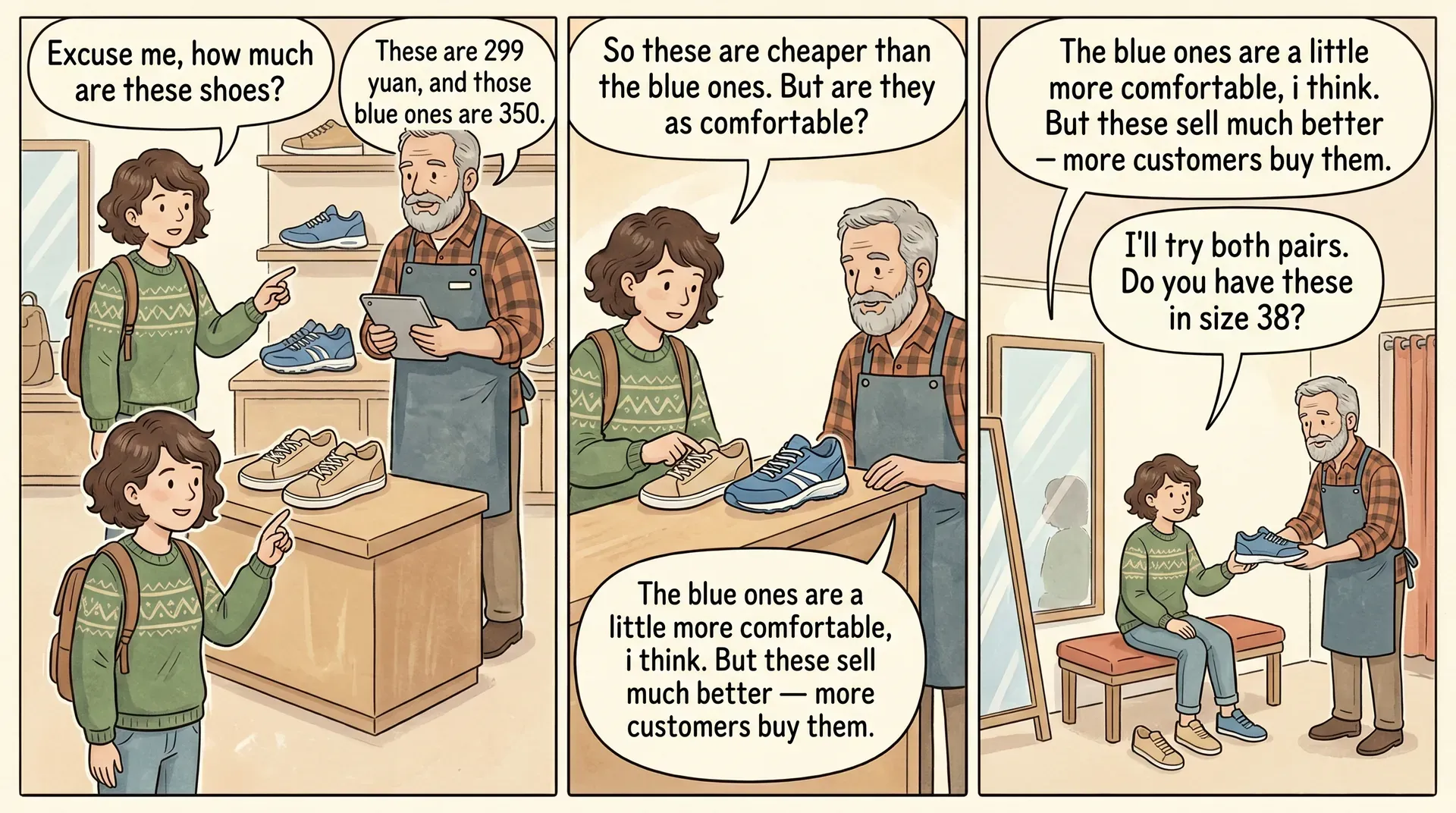
以下对话展示了数量和比较表达在购物场景中的自然运用:
A: Excuse me, how much are these shoes?
(请问这双鞋多少钱?)
B: These are 299 yuan, and those blue ones are 350.
(这双299元,那双蓝色的350。)
A: So these are cheaper than the blue ones. But are they as comfortable?
(那这双比蓝色的便宜一些。但是一样舒适吗?)
B: The blue ones are a little more comfortable, I think. But these sell much better — more customers buy them.
(蓝色的稍微舒适一些。但这双卖得更好——很多顾客买这双。)
A: I'll try both pairs. Do you have these in size 38?
(两双我都试一下。这双有38码吗?)
解析: 这段对话中出现了多种比较结构:“cheaper than”(比较级 + than);“as comfortable”(as … as 疑问形式);“a little more comfortable”(比较级前加程度词);“much better”(比较级前加 much 表示“好得多”)。购物是练习比较级最自然的场景,因为要不断比较价格、质量、款式。
练习题
练习一(选择题):选择正确的数量词
知识点:much 用于不可数名词,many 用于可数名词
“We don't have _____ time before the meeting starts.”空格处应填什么?
A. many
B. much
C. a few
D. few
练习二(选择题):比较级形式
知识点:规则比较级变化,以 -y 结尾变 -ier
“This homework is _____ than yesterday's.”(这个作业比昨天的容易)
A. more easy
B. most easy
C. easier
D. easiest
练习三(选择题):a few 与 few 的情感色彩
知识点:a few = 有几个(正面);few = 几乎没有(负面)
“She has _____ close friends, so she's often lonely.”(她几乎没什么亲密朋友,所以经常感到孤独。)
A. a few
B. few
C. a little
D. much
练习四(情景问答):将中文比较句翻译成英语
知识点:运用比较级 + than 和 not as … as 结构
请将以下中文句子翻译成英语,注意选用合适的比较结构:
① 北京比上海冷得多。(程度差异大)
② 这部电话没有那部好用。(不如)
③ 他跑得和他哥哥一样快。(相同程度)
练习五(情景问答):描述你生活中的比较
知识点:综合运用比较级、最高级和数量表达
请用至少 3 句英文,描述你居住的地方(城市、小区或房间),用到至少一个比较级和一个最高级表达。