疑问句与否定句
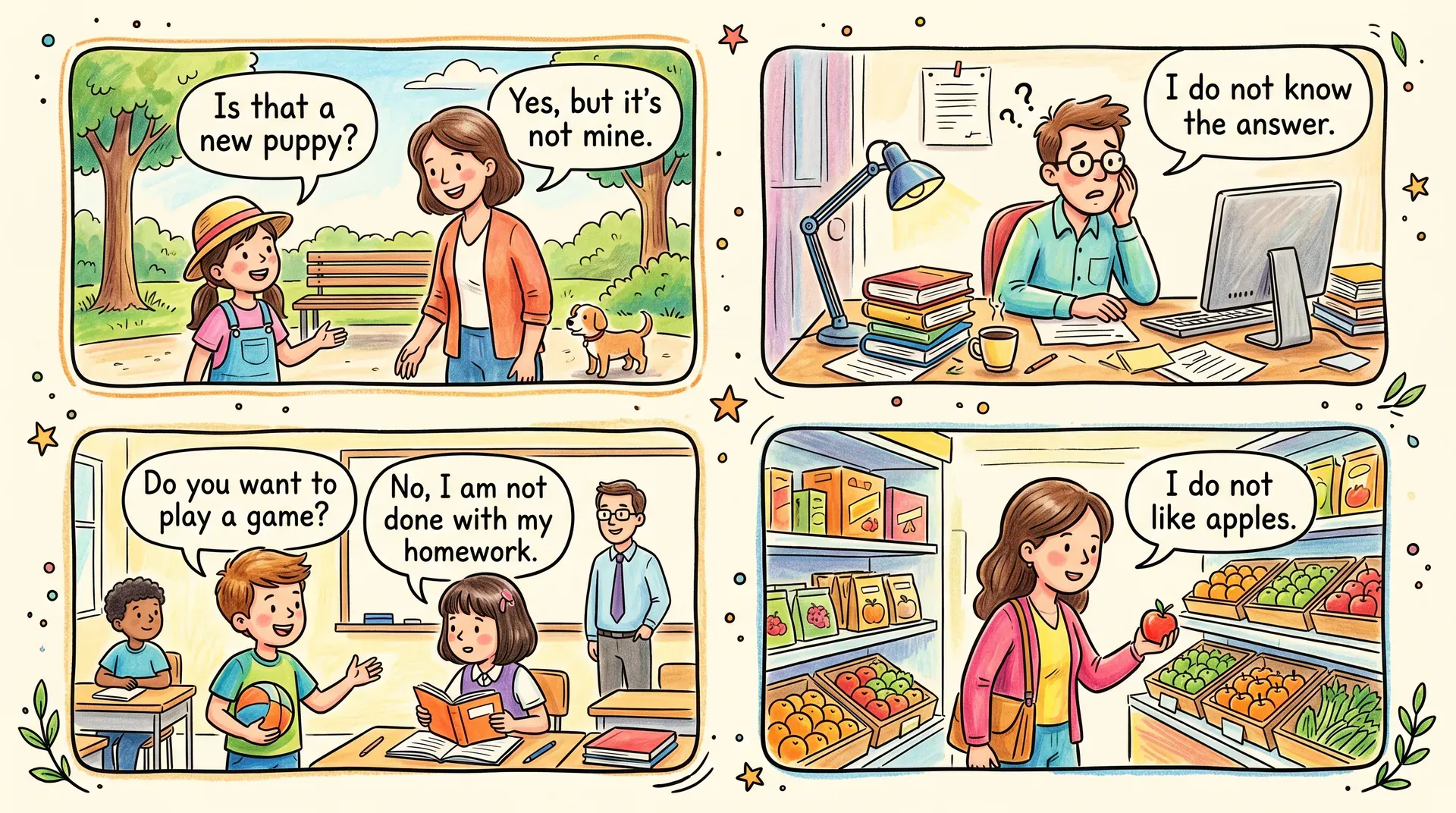
疑问句和否定句是英语交流中最基础、最重要的表达工具之一。没有疑问句,我们就无法向他人提问、获取新知识,也无法表达好奇与疑惑;没有否定句,我们就无法准确地表示拒绝、否定事实、表达“不、没有、从不”等含义,使交流变得片面而不完整。
在日常生活、学习、工作、考试等各种交流场合,我们经常需要针对不同情景灵活使用疑问句与否定句。例如:问时间(What time is it?)、问路(How can I get to the station?)、表达不同意(I don’t think so.)、拒绝邀请(I can’t go with you.)、否定事实(He didn’t come yesterday.)、或者用简洁的句子回答别人的问题(No, I haven’t. / Yes, she does.)。掌握了疑问句和否定句的基本结构和常见句型,不仅有助于通过各类英语考试,更为真实生活中的口语交流、学术讨论甚至写作打下坚实的基础。
此外,地道的英语表达离不开灵活运用不同类型的疑问句(如一般疑问句、特殊疑问句、选择疑问句、反意疑问句等)和否定句(如全否定、部分否定、双重否定等)。不同的语境和交流意图,也会影响疑问与否定的选择与表达方式。真正掌握、理解疑问句和否定句的用法,不只是背诵几个句型,更需要系统梳理它们之间的关系与区别,学会在实际会话中自如切换肯定、否定与提问,做到用英语流畅、准确地表达所有想法和态度。
一般疑问句(Yes/No Questions)
一般疑问句是在英语中最基本的问题类型,其特点是可以用“yes”(是)或“no”(否)来直接作答。常用于确认某项事实、询问对方意见、请求许可、推断信息等,非常常见且实用。英语一般疑问句的构成方式根据动词类型分为以下两类:
be 动词句 → 直接将 be 动词移到主语前
如果句中谓语为 be 动词(am, is, are, was, were),将 be 动词放在主语前即可构成一般疑问句:
更多例句:
主语为 I 的 be 动词一般疑问句使用 Am I...?,例如 I am late. → Am I late?;aren’t I 常用于 I am... 后的附加疑问句,不能混为一谈。
实义动词句 → 加助动词 do/does/did,动词还原为原形
如果句子谓语为实义动词(如 like, work, go, eat 等),需根据时态、主语的不同,在句首加上 do, does(一般现在时的助动词)、did(一般过去时的助动词),而动词需还原为原形:
关键逻辑:
助动词(do/does/did)引入后,原句的动词必须还原为原形。
小贴士:
- 一般现在时主语为第三人称单数(如 he, she, it)时用 does,其他情况用 do。
- 一般过去时不用区分人称,一律用 did。
- 动词要用原形(例如:She plays. → Does she play?)
更多例句:
回答一般疑问句(肯定/否定回答)
一般疑问句通常用简洁的“是/否”结构来回答。回答要用助动词或 be 动词呼应问题,并注意人称和时态的一致:
更自然的简略回答有时只用 Yes / No,但正式或礼貌表达推荐用全句形式。实际口语交流时,也可根据语气补充信息:
- “Do you like music?”
“Yes, I do. Especially jazz.” - “Are you free this evening?”
“No, I'm not. I have to work late.”
4. 其它常见形式
-
情态动词句也遵循前置动词原则:
Can you swim? / Should I call her? / Will they come tomorrow? -
否定疑问句:
用于表达惊讶、与预期不符或加强语气。如:
“Don't you like chocolate?”
“Isn't he at home?”
答案依然用 yes/no,但注意 yes 确认肯定事实,no 确认否定事实,并不按“同意或不同意问句措辞”判断。
掌握一般疑问句类型和回答方法,有助于日常生活、考试和实际交流的自信表达。
特殊疑问句(Wh- Questions)
特殊疑问句以疑问词开头,不能用“是/否”回答,必须提供具体信息:
疑问词 + 助动词/be 动词 + 主语 + 动词(原形)
Who 作主语时不需要助动词:
“Who called you?”— Who 是主语,直接 + 动词(called,过去时) “Who knows the answer?”— Who 是主语,动词用第三人称单数形式(knows)
但当 Who 作宾语时,需要助动词:“Whom did you call?”= “你打电话给谁?”(你是主语,whom 是宾语)
否定句的构成
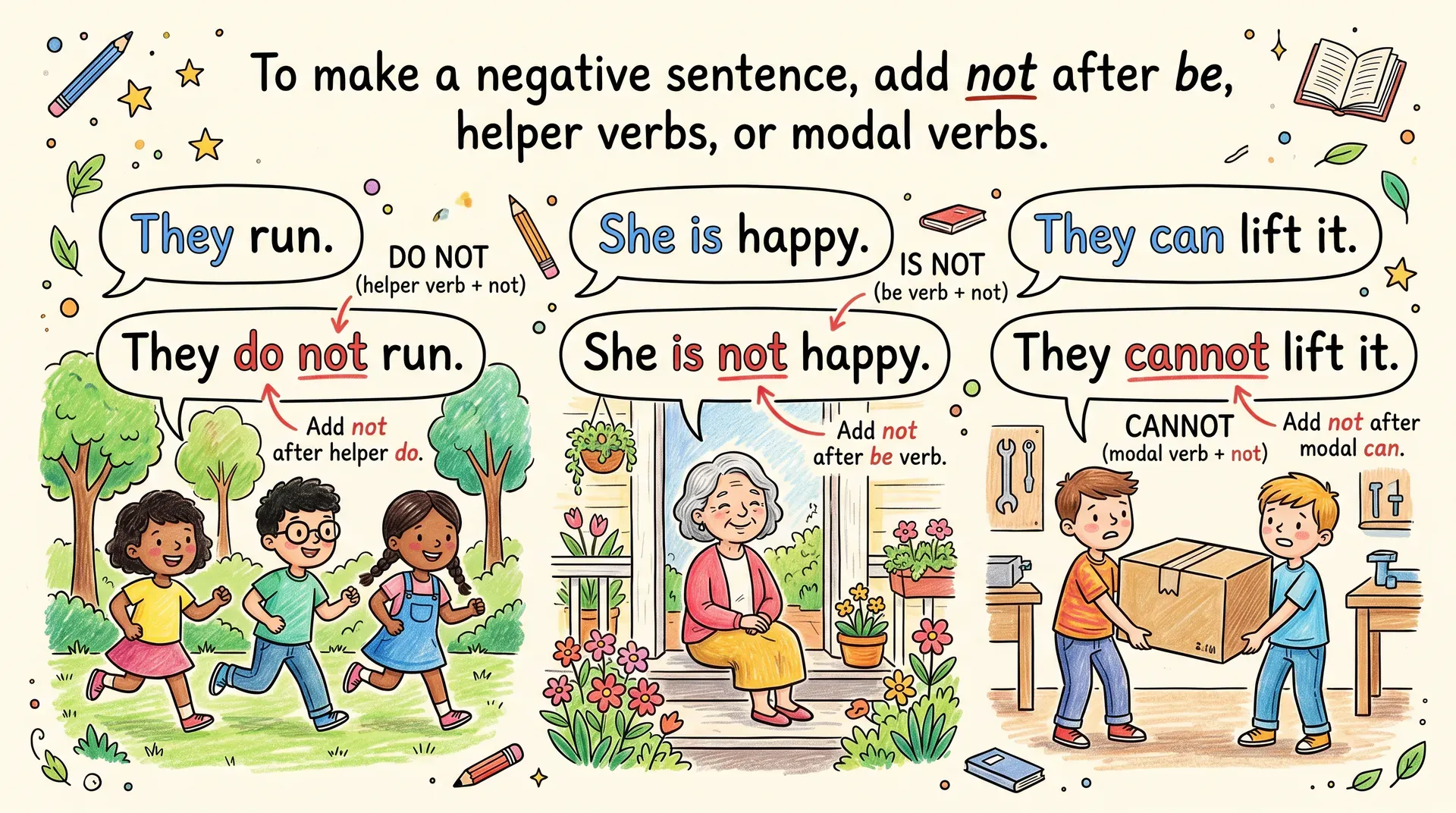
否定句(Negative Sentences)用于表达“不是”、“没有”、“不能”等否定含义。常见的否定句结构如下:
be 动词句的否定 → be 动词 + not
- be 动词包括 am, is, are(现在时)及 was, were(过去时)。
- 缩写形式常用于口语:is not → isn't,are not → aren't,was not → wasn't,等。
实义动词句的否定 → do/does/did + not + 动词原形
do/does 用于现在时,did 用于过去时,否定形式分别为 don't, doesn't, didn't。
注意:否定句中的动词必须还原为原形,即使肯定句是第三人称单数(如:She plays → She doesn't play)或过去式(如:He went → He didn't go)。无论主语是谁,否定句一旦用上 do/does/did 助动词,后面的动词都必须用原形,不能再使用第三人称单数形式(-s结尾)或过去式。例如:
- 错误:She doesn't likes apples.
正确:She doesn't like apples. - 错误:He didn't went home.
正确:He didn't go home.
这一规则适用于所有含有 do/does/did 的否定句和疑问句。
情态动词(can, will, must 等)的否定
直接在情态动词后加 not
有些情态动词有专属缩写,如 can't(cannot)、won't(will not)、mustn't(must not)。
常见否定句错误归纳与纠正
更多否定句例句
- 否定命令句:
- Don’t open the window!(不要开窗!)
- Don’t be late.(不要迟到。)
- 带有 never/nowhere/no one 等否定词:
- She never eats meat.(她从不吃肉。)
- No one knows the answer.(没人知道答案。)
- There is nowhere to park.(没有地方停车。)
- 句首含否定副词的倒装句(正式文体):
- Never have I seen such a beautiful place.
(我从未见过如此美丽的地方。) - Not only did he lose his wallet, but he also lost his phone. (他不仅丢了钱包,还丢了手机。)
掌握不同结构的否定句,可以帮助你更准确地表达否定和禁止等语气,也能避免常见语法错误。
反意疑问句(Tag Questions)
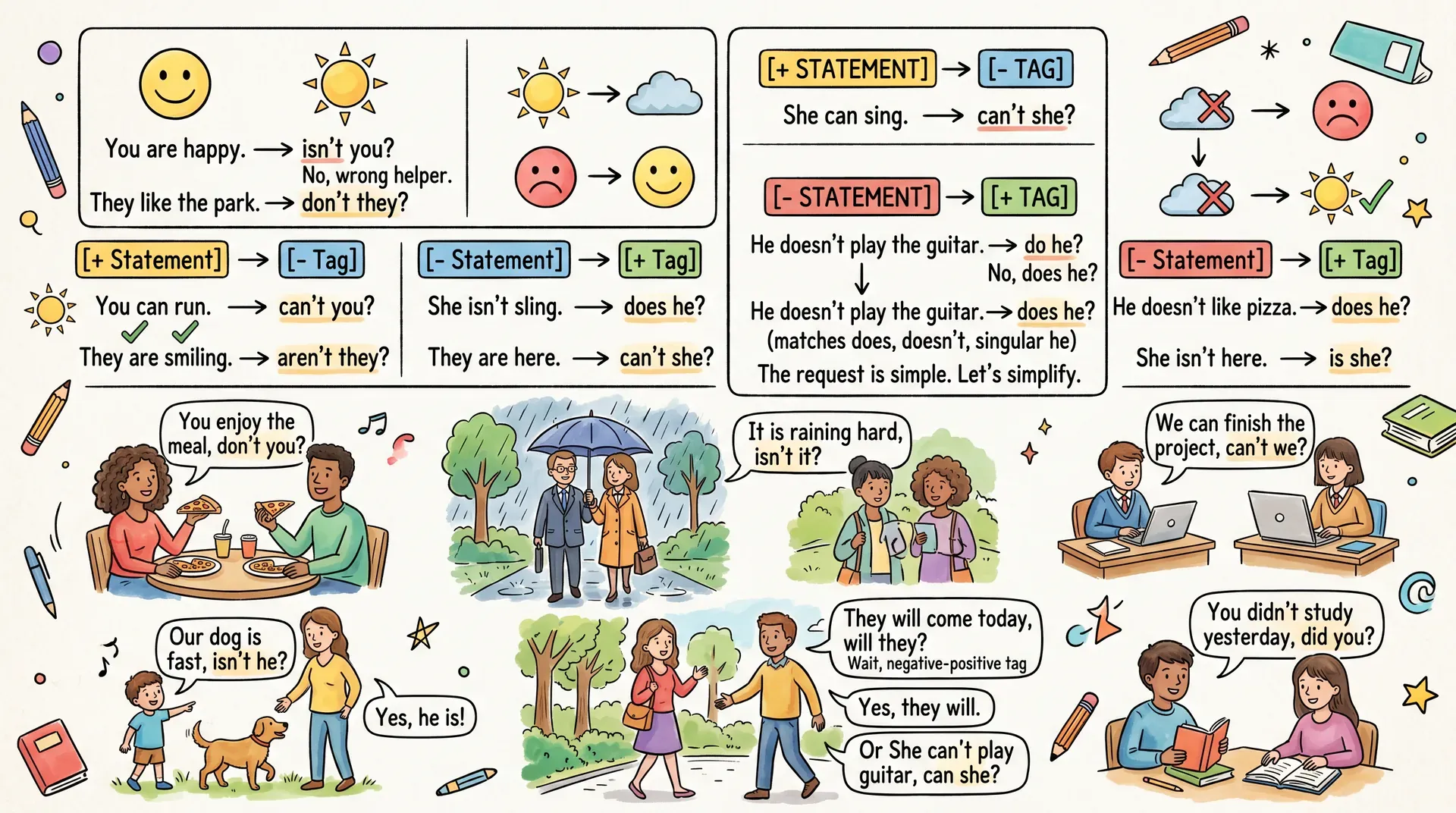
反意疑问句是在陈述句末尾加一个简短疑问,用来寻求确认,语调上升代表真的不确定,语调下降代表寻求同意:
- It's a beautiful day, isn't it?(天气真好,不是吗?)
- You haven't been here before, have you?(你以前没来过,对吗?)
否定词的扩展
英语中有多种方式表达“否定”,不只是 not:
英语否定与中文否定的区别:
中文可以双重否定(“没有什么不好的”),但英语通常不使用双重否定,否则意思会变成肯定:
✗ I don't know nothing.(双重否定 = 我知道一些事) ✓ I don't know anything. / I know nothing.
场景对话
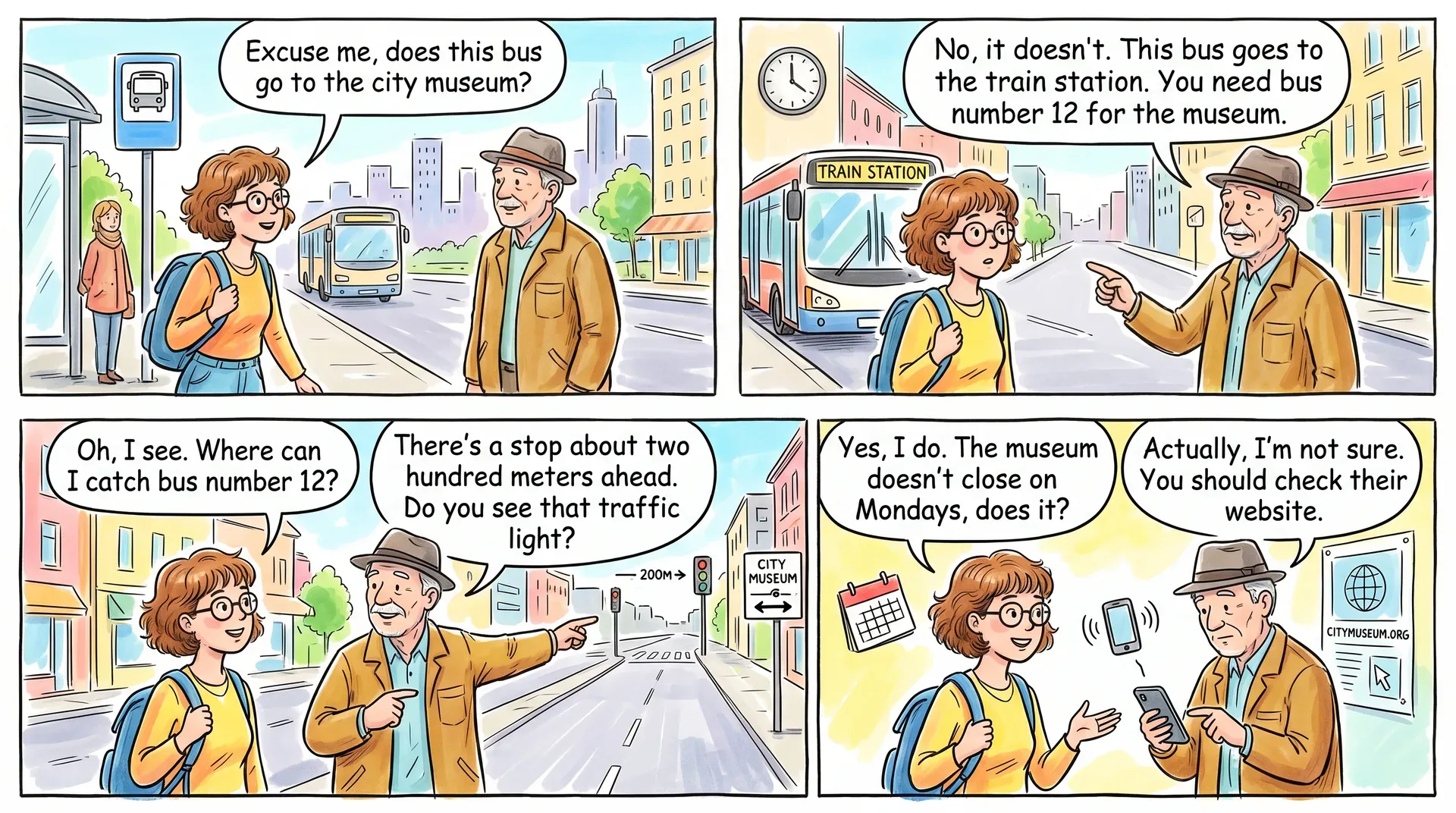
A: Excuse me, does this bus go to the city museum?
(请问这辆公共汽车去市博物馆吗?)
B: No, it doesn't. This bus goes to the train station. You need bus number 12 for the museum.
(不,不去。这辆车去火车站。去博物馆你需要乘12路公共汽车。)
A: Oh, I see. Where can I catch bus number 12?
(哦,明白了。我在哪里可以坐12路?)
B: There's a stop about two hundred meters ahead. Do you see that traffic light?
(前方大约200米有一个站台。你看到那个红绿灯了吗?)
A: Yes, I do. The museum doesn't close on Mondays, does it?
(是的,看到了。博物馆周一不关门,对吗?)
B: Actually, I'm not sure. You should check their website.
(实际上我不确定。你应该查一下他们的官网。)
疑问句与否定句分析:
- “does this bus go to”— 实义动词一般疑问句(does + 主语 + 原形)
- “No, it doesn't”— 简短否定回答
- “Where can I catch”— Wh- 疑问句(where + 助动词 can)
- “Do you see”— 一般疑问句
- “doesn't close… does it?”— 反意疑问句(否定陈述 + 肯定尾句)
练习题
练习一(选择题):构成正确疑问句
知识点:实义动词疑问句用 does,主动词还原为原形
将“She studies Chinese every day.”改成正确的疑问句:
A. Studies she Chinese every day?
B. Is she studying Chinese every day?
C. Does she study Chinese every day?
D. Do she study Chinese every day?
练习二(选择题):选择正确的否定句
知识点:does 出现后,主动词必须还原为原形
以下哪个否定句是正确的?
A. He doesn't knows the answer.
B. She don't like vegetables.
C. They doesn't go to the gym.
D. My brother doesn't have a car.
练习三(选择题):特殊疑问词的选用
知识点:根据回答内容选择正确的疑问词
“_____ does she go to work?”回答是“By subway.”
A. Where
B. How
C. When
D. Why
练习四(情景问答):将陈述句改成多种疑问形式
知识点:能将一个陈述句变为:一般疑问句、Wh- 疑问句、反意疑问句
基于以下句子,写出三种疑问句形式: “Tom goes to the gym every morning.”
① 一般疑问句(可以用是/否回答) ② What time 特殊疑问句(问 Tom 几点去) ③ 反意疑问句(寻求确认)
练习五(情景问答):对话补完
知识点:综合运用疑问句和否定句,完成自然对话
以下是一段不完整的对话,请用疑问句或否定句补完空格处(每处一句):
A: ① _______________(问 B 是否喜欢运动)
B: Not really. I don't like going to the gym. ② _______________(B 反问 A 是否经常运动)
A: Yes, I run every morning. ③ _______________(A 问 B 为什么不喜欢运动)
B: I find it boring, to be honest. ④ _______________(B 反意疑问句:你觉得这不奇怪吗?—“You don't find it strange, do you?”类似)
A: Actually, I used to feel the same way, but now I really enjoy it.