表达同意与不同意
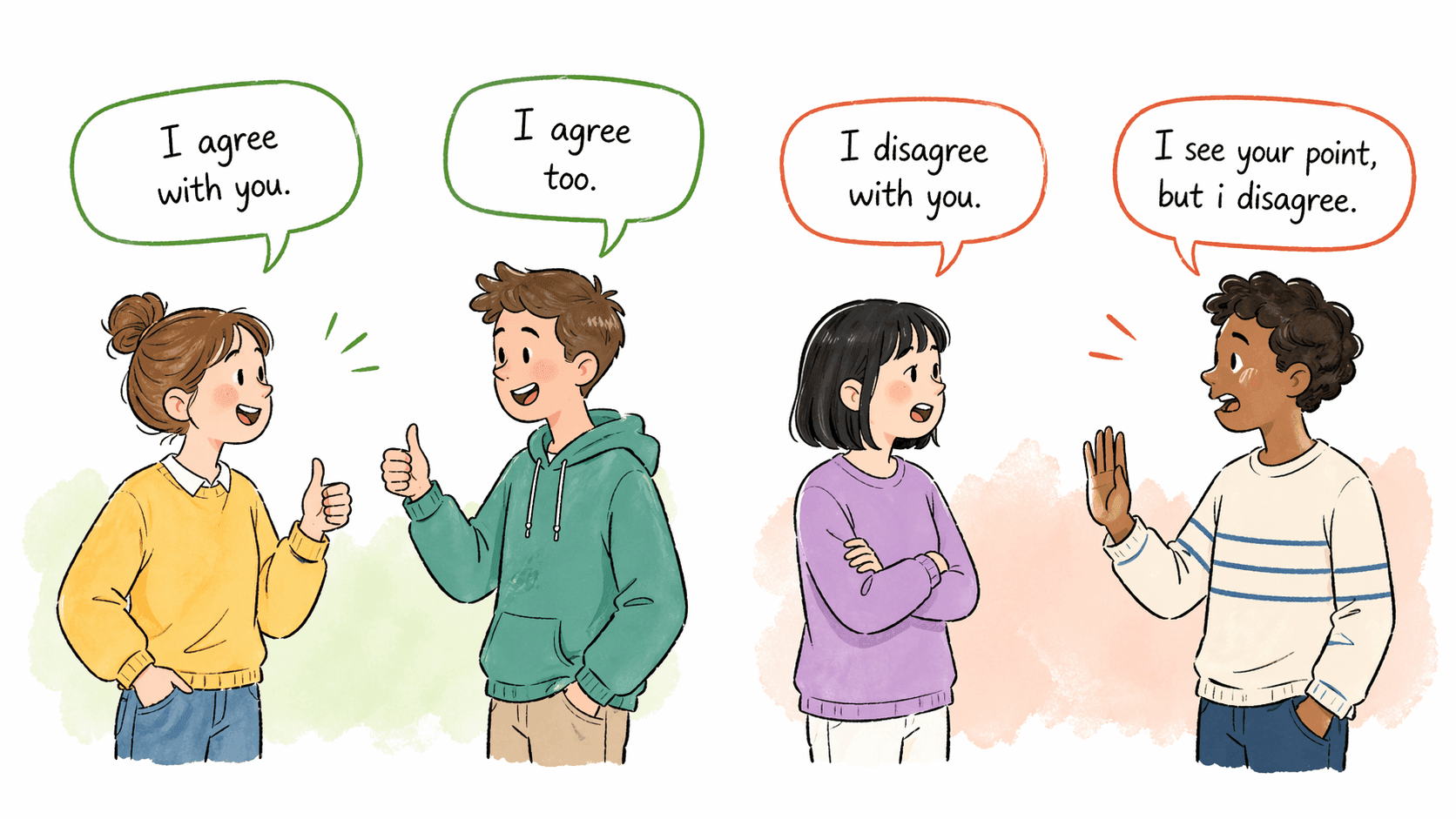
在英语交流中,清楚而得体地表达自己的同意或不同意非常重要。这不仅能展现你的思考力,也有助于让对话更深入、更有建设性。直接用“Yes”或者“No”通常会让对话迅速结束,甚至显得冷淡。但如果你能够使用更加多样和细腻的表达方式来回应,不仅能让话题延续,还能让对方感受到你的尊重、用心和思考。例如,当你表达同意时,可以进一步补充自己的理由,推动对话深入;而当你表达不同意见时,也能以礼貌、恰当的方式,让双方保持良好的沟通氛围。
这些表达方式能够帮助你在讨论不同话题时,更准确地说明自己的想法,既能认可别人的观点,也能自信、礼貌地提出异议。无论是在表达全力支持、部分认同,还是需要委婉表达分歧时,掌握多样的说法都是提升沟通能力的关键。
善于表达同意与不同意,也是建立良好人际关系、避免误解和冲突的基础能力。在日常生活、学习场景、职场交流、甚至与朋友闲聊中,我们都经常会遇到需要表达立场的时刻。能够得体、有逻辑地说明自己的立场,不仅能让你在交流中更加自信,也有助于对方理解你的真实想法,减少不必要的误会。因此,掌握更多元、自然的表达方法,对于每一位英语学习者来说,都是非常实用且值得投入时间提升的重要沟通技能。
完全同意:不只是“Yes”
当你真心同意对方时,有很多比单纯的“Yes”更有表现力、更能展现思考与认同感的表达方式。这些表达不仅让对话继续深入,也能让对方感受到你的积极参与和支持。
高频表达举例:
- “Exactly!” — 正是!(最简洁有力,快速响应,用于点头称是时)
- “Absolutely!” — 完全同意!(强烈肯定,语气坚定)
- “That's exactly what I think.” — 这正是我的想法(强调双方观点的一致)
- “I couldn't agree more.” — 我再同意不过了(极致同意,经常用于表示强烈支持)
- “You're totally right.” — 你完全说得对
- “I was thinking the same thing.” — 我也在想同样的事
- “That's a really good point.” — 这个观点说得很好
- “That's spot on.” — 说得非常准确(地道口语,表达观点非常到位)
- “You took the words right out of my mouth.” — 你说出了我想说的话
- “I'm with you 100%.” — 我百分之百支持你
- “No doubt about it.” — 毫无疑问
- “Absolutely, that's the way I see it too.” — 绝对如此,我也是这么认为的
表达完全同意的用法分析:
-
“I couldn't agree more.” 是英语里表达完全同意的经典句型,字面意思是“我没办法更同意了”,即“我完全同意”。这个否定词与比较级结合的结构,是英语表达中常见的加强方式——不是直接说“我非常同意”,而是说“我的同意程度已经无法更高”,情感更强烈、更有分量。
-
“Exactly!” 和 “Absolutely!” 都属于反应迅速、简明扼要但情感充沛的表达,适合在口语交流中使用。前者强调观点的精准,后者强调立场的坚定。
-
“That's a really good point.” 除了表达同意,还兼具鼓励对方深入说下去的作用,适用于会议、讨论场景。
场景搭配举例:
- 朋友提出一个好建议时,你可以说:“That's absolutely right, I was thinking the same thing.”
- 会议中同事阐述你认同的结论,你可以应和:“Exactly! That sums it up perfectly.”
- 在辩论或小组讨论中,表达衷心支持:“I totally agree with you on this issue.”
常见误区与建议: 单一地重复“Yes”或者简单的“Agree”可能会让对方觉得你缺乏投入或敷衍了事。更丰富、有个性的表达,不仅能让交流更顺畅,也有助于建立良好的关系和信任感。你可以尝试结合理由解释自己的同意,例如:“That's exactly what I think, because...”后面补充你的原因,这样对话将更具深度和建设性。
部分同意:最常用的立场
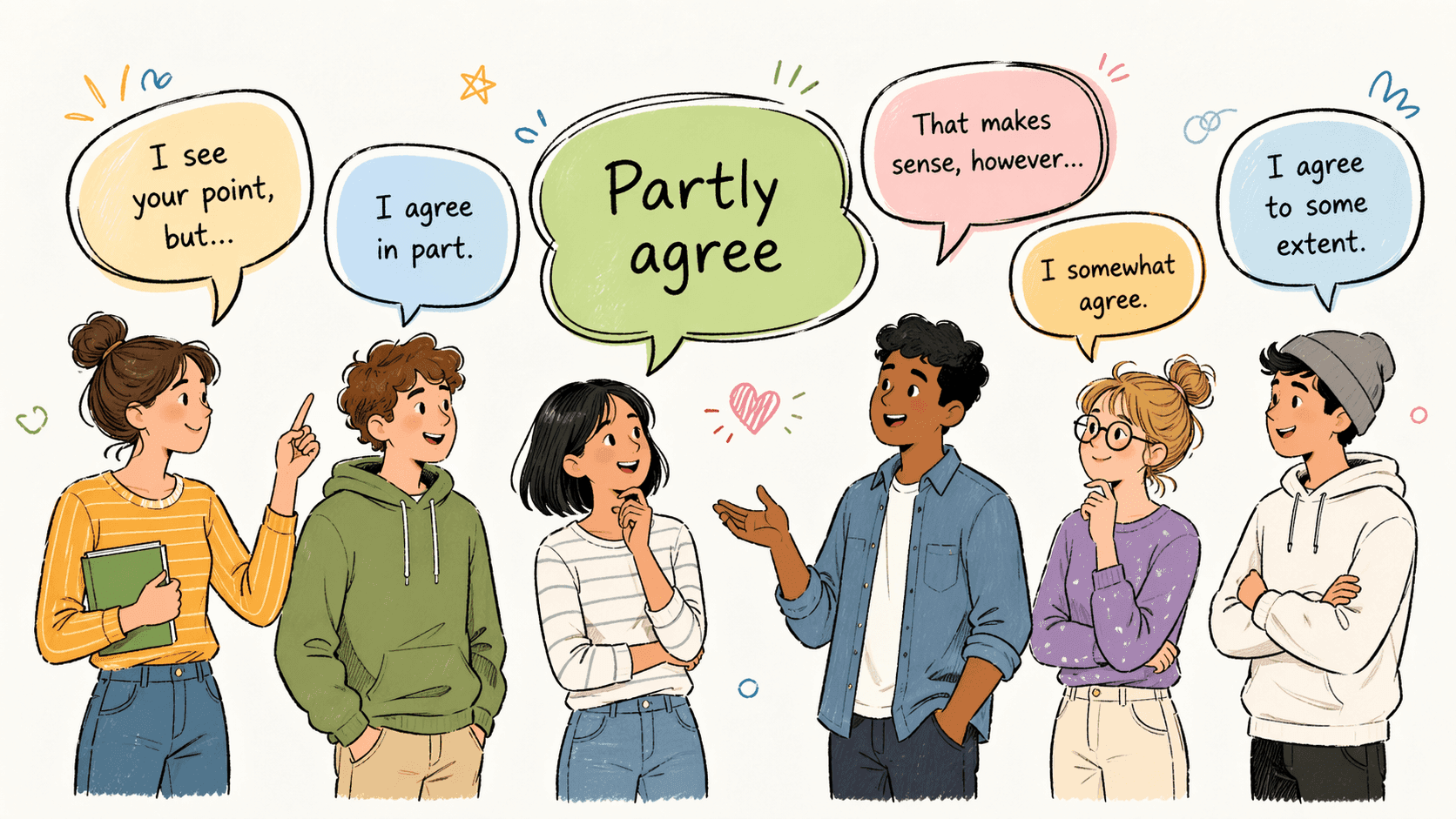
在真实交流场景中,“完全同意”或“完全不同意”其实很罕见。绝大多数情况下,我们都处在“部分同意”的区域,也就是:你认为对方有合理之处,但你又有不同的思考或补充。这种表达是英语对话中的常态,是最实用、最需要练习的表达方式。
常见部分同意表达:
- “That's true to some extent, but...” — 某种程度上是对的,但……
- “I see what you mean, but...” — 我理解你的意思,但……
- “You have a point, however...” — 你说得有道理,不过……
- “I agree with you up to a point, but...” — 我在一定程度上同意你,但……
- “There's something to that, but I think...” — 这有一定道理,但我认为……
- “I partly agree, but...” — 我部分同意,但……
更多补充表达:
- “I can see where you're coming from, but...” — 我能理解你的出发点,但……
- “That's a fair point, though I also think...” — 这是个合理的观点,不过我还觉得……
- “I get your point, but for me...” — 我明白你的意思,但对我来说……
- “That makes sense, but at the same time...” — 那很有道理,但与此同时……
用法分析:
部分同意时,表达顺序很重要:
- 先认可对方的观点——哪怕只是部分接受;
- 用转折词(but, however, though, at the same time等) 做衔接;
- 表达自己的主张或补充。
这种表达法比直接反驳要柔和、友好,能减少冲突和尴尬,展现你尊重和倾听对方。哪怕你观点相左,也能推动对话深入,找到共识。
场景示例:
A: The new policy increases efficiency for the team.
(新政策提升了团队效率。)
B: That's true to some extent, but I think it also adds more pressure on everyone.
(在某种程度上是对的,不过我觉得这同时也给大家带来更多压力。)
或者:
A: Online learning is very convenient.
(线上学习很方便。)
B: I agree with you up to a point, but I think face-to-face classes offer better interaction.
(我在一定程度上同意你,但我觉得面对面课堂有更好的互动。)
礼貌不同意:有立场但不冒犯
当你确实和对方观点不一致时,用合适的表达方式可以让你的分歧听起来不突兀、不冒犯,有助于维持好的关系与氛围。英语表达中,委婉、礼貌的不同意有很多“层次感”,根据场合和你与对话者的关系选择使用。
较礼貌与缓和表达:
- “I'm not sure I agree.” — 我不太确定我同意
- “I see it a bit differently.” — 我看法有些不同
- “I'm not sure that's quite right.” — 我不确定这完全正确
- “I understand your point, but I think...” — 我理解你的观点,但我认为……
- “That’s one way to look at it, but...” — 那是一种看法,不过……
中性表达:
- “I'm afraid I see it differently.” — 我恐怕看法不同
- “Actually, I think there's another way to look at it.” — 其实,我认为也可以从另一角度看
- “With all due respect, I think...” — 恕我直言,我认为……
- “I'm afraid I can't agree with you on this.” — 恐怕在这个问题上我不能同意您的看法
更直接但保持礼貌:
- “I disagree, actually. I think...” — 其实我不同意,我认为……
- “That's an interesting point, but I think the evidence suggests...”
(这是个有趣的观点,但我觉得证据表明……) - “To be honest, I see it differently.” — 说实话,我的看法不同
- “I have to disagree on that.” — 这点我得不同意
在英语文化里,“有礼貌地表达不同意见”不仅是被接受,甚至是被鼓励的。清楚地、有逻辑地表态比一味迎合更受尊敬。关键在于方式:先承认对方观点的合理性,再补充你的不同点,用转折或缓冲语言衔接,避免直接说“No”。
实用建议:
- 附上简单理由(而不是只说“I disagree”),可以让对方更容易理解和接受你的立场。
- 保持语气温和,用“I think… / I feel… / I believe…”等词引入你的观点,会显得更加友好。
软化不同意见的技巧
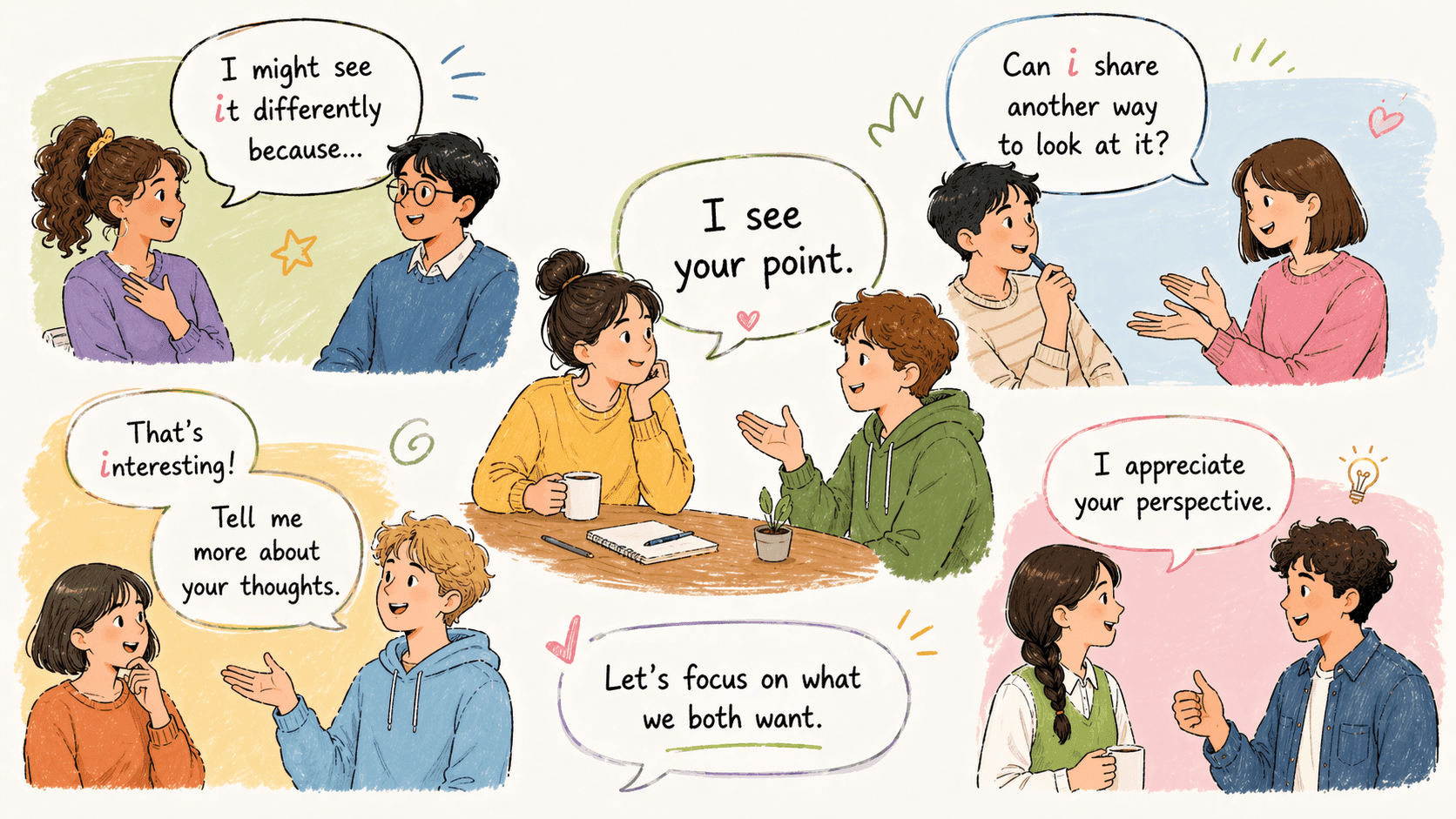
在表达分歧时,适当使用一些“软化”语言(hedging language),能让你的话听起来更委婉,减少冲突,为对方保留空间,提升沟通舒适度。这类表达方式英文里极其常见。
常用软化表达:
- “I think... / I feel... / I believe...” — 我认为/我觉得/我相信(表明是个人观点而非绝对真理)
- “Maybe... / Perhaps... / It seems to me that...” — 也许…/或许…/在我看来…
- “I might be wrong, but...” — 也许我理解错了,但……
- “In my opinion,...” — 在我看来……
- “From my perspective,...” — 从我的角度看……
承认对方观点+转折(推进讨论):
- “That's a good point.” / “I see where you're coming from.” / “I understand your point.”
(先正面回应) - 再加:“But I think... / However,... / At the same time,...”
(然后补充自己的不同意见)
示例对话:
A: This approach will save us a lot of time.
(这个方法会为我们省下很多时间。)
B: That's a good point. At the same time, I think the initial setup could be quite complex.
(这个观点很不错。与此同时,我觉得最初的设置可能会相当复杂。)
小贴士: 下次表达不同看法时,不妨多加几个 hedging 句型,让沟通变得更柔和、更有理有据,也更容易让对方接受你的建议或反驳。
对话示范:讨论一个有争议的话题
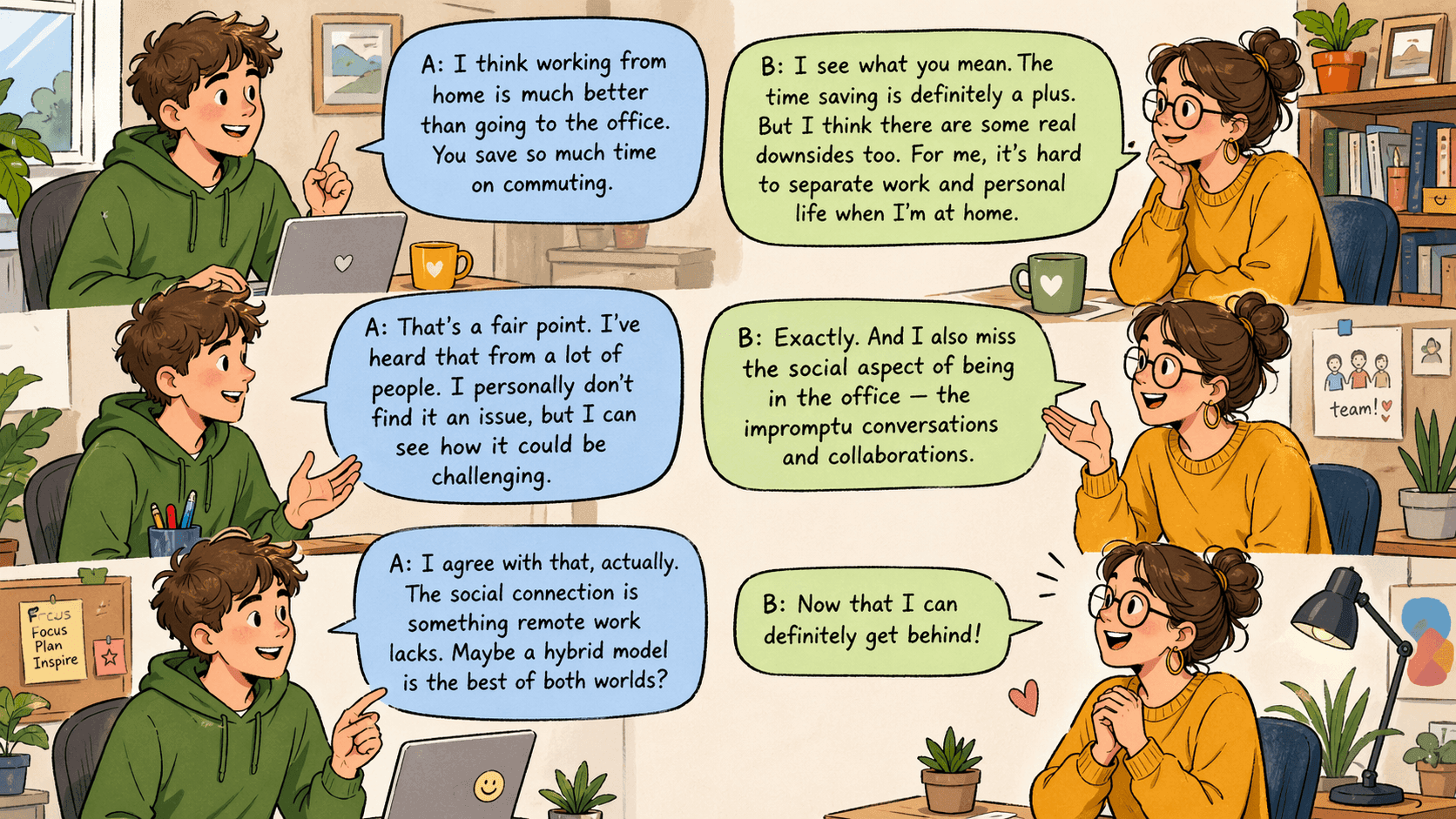
A: I think working from home is much better than going to the office. You save so much time on commuting.
(我认为居家办公比去办公室好得多。你省了很多通勤时间。)
B: I see what you mean. The time saving is definitely a plus. But I think there are some real downsides too. For me, it's hard to separate work and personal life when I'm at home.
(我理解你的意思。节省时间确实是一个优点。但我认为也有一些真正的缺点。对我来说,在家的时候很难把工作和私生活分开。)
A: That's a fair point. I've heard that from a lot of people. I personally don't find it an issue, but I can see how it could be challenging.
(这是个合理的观点。我从很多人那里听到过这个。我个人不觉得这是个问题,但我能理解这可能是个挑战。)
B: Exactly. And I also miss the social aspect of being in the office — the impromptu conversations and collaborations.
(确实。我也很怀念在办公室的社交方面——那种即兴的对话和合作。)
A: I agree with that, actually. The social connection is something remote work lacks. Maybe a hybrid model is the best of both worlds?
(其实这点我同意。社交连接是远程工作所缺乏的。也许混合模式是两全其美的方案?)
B: Now that I can definitely get behind!
(这个我完全支持!)
对话要点:
整段对话中,双方都没有“完全同意”或“完全不同意”——而是在互相认可对方的合理之处(“That's a fair point”“I see what you mean”),同时表达自己不同的看法(“But I think...”)。这正是真实的英语讨论应该有的节奏。
“I can get behind that!”是“我完全支持这个想法!”的地道口语表达,比“I agree”更生动。
确认理解再回应
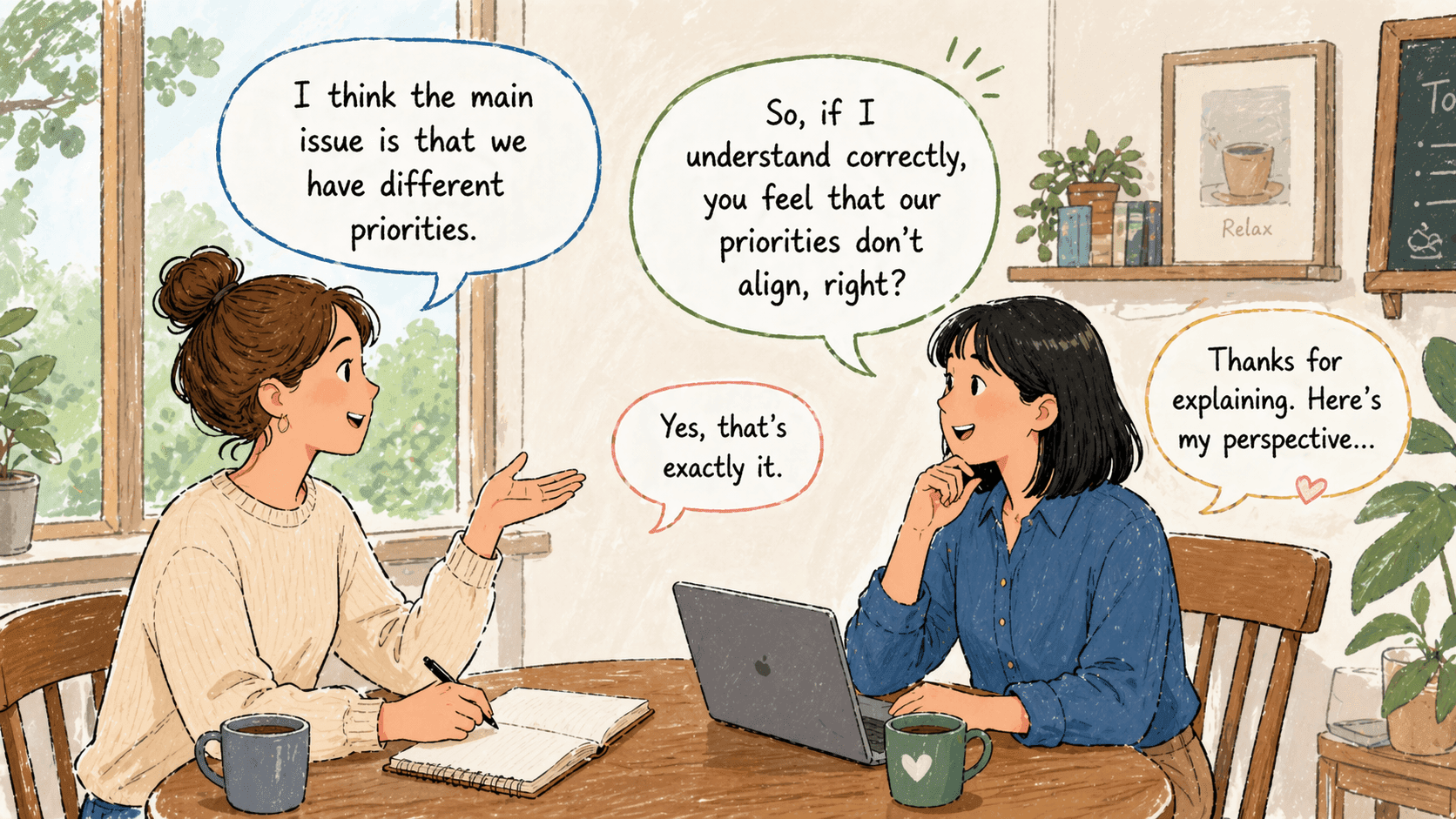
在表达立场之前,先确认自己理解了对方的意思,能避免很多不必要的误解。这样做不仅可以让对方感受到被尊重和重视,还能为自己的立场表达打下基础。如果理解有偏差,及时修正比事后解释更有效。
你可以用以下句式来确认理解:
- “Do you mean to say that...?” — 你的意思是说……吗?
- “If I understand you correctly, you're saying...” — 如果我理解正确,你是说……
- “So you're suggesting that...?” — 所以你在建议……?
- “Just to make sure I understand — your point is...?”
(只是为了确认我理解——你的观点是……?) - “Let me make sure I got this right. Are you saying that...?”
(让我确认一下,我没理解错的话,你是说……?) - “Correct me if I'm wrong, but you mean...”
(如果我错了请纠正我,但你是指……?)
这些表达不仅适合工作、学习等正式场合,在朋友间的日常对话里也很实用。例如:
A: I think we should split the project into two phases and launch early. (我觉得我们应该把项目分成两个阶段,早点上线。)
B: Just to make sure I understand — you want us to launch with a simpler version first, and add features later? (只是为了确认我理解正确——你是想让我们先推出一个简化版,然后再逐步添加功能吗?)
通过这样的提问,你表现出对沟通的重视,也更容易获得对方的认可和信任,把对话拉到同一频道上。养成在表达前“重复确认”这一好习惯,可以让交流变得更有效,也能避免不必要的争执。
练习题
练习一(选择题)
知识点:“I couldn't agree more”的正确含义
对方说“Learning English takes time and consistent practice.”,你完全同意。下面哪个回应最有力?
A. Yes, I think so.
B. That's true.
C. I couldn't agree more — consistency is everything when learning a language.
D. OK.
练习二(选择题)
知识点:部分同意的结构
朋友说“Social media is completely bad for mental health.”,你认为有一定道理,但你觉得情况更复杂,下面哪个回应最体现部分同意?
A. I agree!
B. You're completely wrong.
C. I see where you're coming from — it can definitely be harmful. But I think it also depends on how you use it. Some people use it to stay connected with friends and family, which is positive.
D. No, social media is fine.
练习三(选择题)
知识点:礼貌表达不同意的用词
你的上司在会议上提出了一个你不认同的方案,你想礼貌地表达不同意,下面哪个表达最适合职场场合?
A. That's wrong!
B. I disagree.
C. With all due respect, I think there might be some challenges with this approach that are worth considering.
D. I hate this idea.
练习四(情景问答)
知识点:用三明治结构表达不同意见
情境: 你的朋友说“University degrees are a waste of time. You can learn everything online for free.”(大学学位是浪费时间,你可以在网上免费学到一切。)
你认为这个观点太绝对了——在线学习确实有价值,但大学教育还提供了人脉、社交经验和一些在线学习无法替代的东西。请用英语写出你的回应(4-5句话),用“三明治结构”:先认可 → 转折 → 给出理由。
练习五(情景问答)
知识点:在讨论中确认理解对方的意思
情境: 朋友说“I think people are becoming too dependent on technology these days.”(我觉得现在人们对科技太过依赖了。)在回应之前,你想先确认他的意思——他是指所有科技,还是特指手机和社交媒体?请用英语写出你的确认问句,然后基于他的回答(你可以自行设定他说的是“主要是手机和社交媒体”)写出你的部分同意回应(共4-5句)。